Exiled by Hollywood, Claimed by History: The Writer the Blacklist Couldn't Silence
The Day the Gavel Fell
In October 1947, Dalton Trumbo walked into a Washington hearing room already knowing how it would end. He was one of the most successful screenwriters in Hollywood — the man behind Kitty Foyle, the writer studios fought over, the guy whose name on a script meant the picture would get made. None of that mattered to the House Un-American Activities Committee. What mattered was the question: Are you now, or have you ever been, a member of the Communist Party?
Trumbo refused to answer. So did nine others. And just like that, the Hollywood Ten were finished — at least on paper.
What actually happened over the next decade was something nobody in that hearing room could have predicted. The blacklist didn't kill Dalton Trumbo's voice. It sharpened it into something that would outlast every congressman who voted to destroy it.
A Career Built on Craft, Dismantled by Fear
Before the blacklist, Trumbo was the highest-paid screenwriter in Hollywood. Born in Montrose, Colorado, in 1905, he'd clawed his way up from night shifts at a bread factory to the upper echelons of the studio system. His 1939 anti-war novel Johnny Got Its Gun — written from the perspective of a quadruple amputee veteran who can't communicate with the outside world — announced him as someone with a moral compass that pointed somewhere deeper than box office receipts.
He joined the Communist Party in 1943, during a period when the Soviet Union was an American ally and the party had a real foothold in labor organizing across the country. By the time the war ended and the political winds shifted, that membership had become a target painted on his back.
When the blacklist hit, the studios didn't just stop hiring him. They made it professionally dangerous for anyone to be associated with him. He was radioactive. He was done.
Except he wasn't.
Writing in the Dark
What the blacklist actually did was force Trumbo underground — and underground, something unexpected happened. Freed from the constraints of studio notes, freed from the social performance of being a Hollywood player, he wrote with a kind of ferocious clarity that his earlier, more comfortable career hadn't quite required.
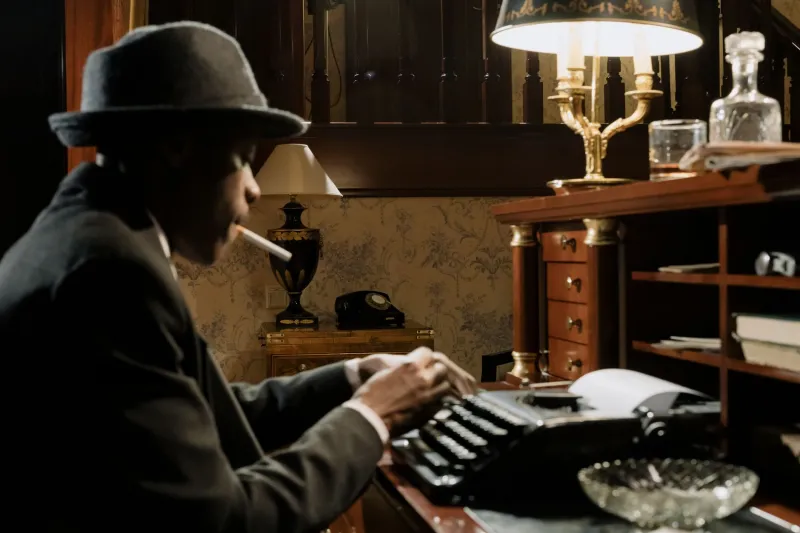
He relocated his family to a farm in Highland Park, then eventually to Mexico, and kept writing. Under pseudonyms — "Robert Rich," "Sam Jackson," and dozens of others — he ghostwrote scripts for producers willing to look the other way. The work was lower-paid, often uncredited, and sometimes handed off to front men who accepted awards on his behalf.
One of those awards was an Academy Award.
In 1956, the film The Brave One won the Oscar for Best Original Screenplay. The credited writer was "Robert Rich." When no one came forward to collect it, the industry squirmed. Everyone in the room knew what was happening. The blacklist was being exposed, right there on the Oscars stage, as a moral embarrassment.
Then, in 1960, the dam broke entirely.
Spartacus and the Beginning of the End
Kirk Douglas was producing and starring in Spartacus, the epic story of a slave rebellion against Rome. He hired Trumbo to write it — and then, in an act of deliberate defiance, put Trumbo's real name on the screen.
President-elect John F. Kennedy crossed an American Legion picket line to see the film. That moment — a future president refusing to honor the blacklist — marked the beginning of its collapse.
Trumbo's name was back. But something had changed, and it wasn't just his reputation.
The Credential You Can't Manufacture
The years in exile had done something to Trumbo that success never could have. They had tested him. He had refused to name names, refused to cooperate, refused to trade other people's livelihoods for his own comfort. That refusal cost him enormously — financially, professionally, personally. And it gave him something that the writers who cooperated with HUAC could never reclaim: an unimpeachable record.
When Trumbo spoke about artistic freedom, about the relationship between power and storytelling, about what Hollywood owed to the truth, people listened differently than they had before. He wasn't theorizing. He had lived it. He had been ground up by the machine and had come out the other side still standing, still writing, still refusing to simplify the world into comfortable fictions.
His 1970 essay collection Additional Dialogue — letters written during the blacklist years — became a document that film students and journalists returned to again and again. Not because it was triumphant, but because it was honest about the compromises, the humiliations, the moral complexity of surviving under a system designed to crush dissent.
What the Blacklist Couldn't Take
Trumbo died in 1976, but the industry spent the following decades reckoning with what had been done in its name. In 1993, the Writers Guild of America restored his credit on Roman Holiday, which had won Audrey Hepburn her Oscar in 1953. In 2011, the Academy gave a posthumous Oscar to his real name for The Brave One.
Those restorations mattered. But the more durable legacy was the idea he left behind — that the most powerful voice in any room is often the one that survived being silenced.
The blacklist had intended to make an example of Dalton Trumbo. It did. Just not the example anyone planned.
He became proof that exile can be a kind of education, that being pushed to the margins can clarify what you actually believe, and that the industry's attempt to erase him had instead preserved him — intact, uncompromised, and ultimately impossible to ignore.
Some reputations are built in the spotlight. The ones that last are usually built in the dark.