Forty Dollars and a Dream
The ship manifest from 1952 lists her simply as "Anna K." — one of thousands of European immigrants arriving in New York with little more than hope. What it doesn't capture is the forty dollars sewn into the lining of her coat, or the way she studied every face on the dock, trying to decode this new world through expression alone.
Anna Kowalski had left behind a war-torn continent where her family's small tailoring business had been destroyed twice — once by bombs, once by politics. At 28, she was starting over in a country where she couldn't even ask for directions.
The garment district became her university, and every 14-hour shift was a lesson in survival.
The Factory Floor Education
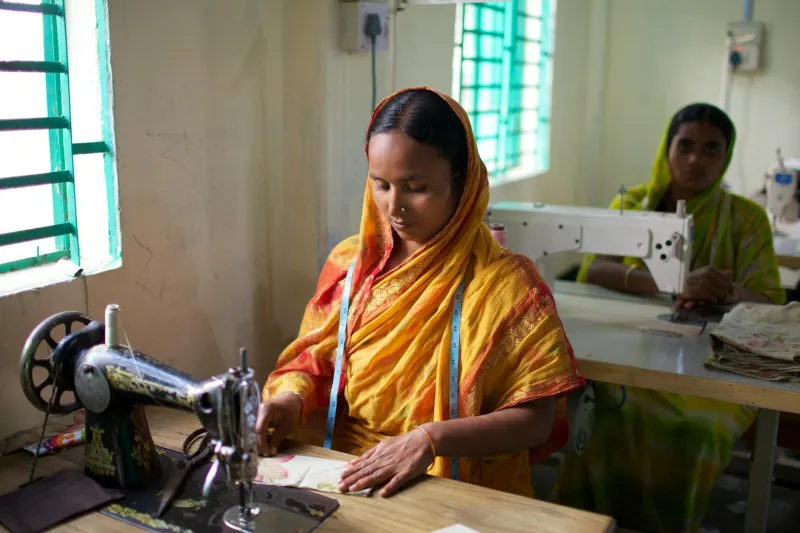
Anna's first job was at Goldstein & Sons, a mid-tier manufacturer that produced dresses for department stores across the Midwest. The work was brutal — bent over sewing machines in poorly ventilated rooms, racing against quotas that seemed designed to break spirits along with backs.
But while her fellow seamstresses saw only exploitation, Anna saw opportunity. She couldn't understand the conversations around her, but she could read the rhythm of the business. She noticed which styles sold out first, which fabrics the floor supervisors handled with extra care, which orders made the executives smile when they walked through.
"I had nothing to lose," she would later explain. "When you start with nothing, every piece of information is treasure."
Anna began staying late, not for overtime pay, but to study the patterns and construction techniques of the higher-end pieces. She memorized the weight of quality fabric, the feel of precise stitching, the small details that separated a $15 dress from a $50 one.
Language Barriers Become Bridges
Not speaking English turned out to be an unexpected advantage. While Anna couldn't participate in office gossip or political maneuvering, she became invisible in meetings where executives discussed strategy. They spoke freely around her, assuming she couldn't understand their concerns about rising costs, changing tastes, and market pressures.
She understood more than they realized. Numbers are universal, and Anna had a mathematician's mind for patterns. She began to see connections that native speakers missed — how the complaints from Midwest buyers aligned with the fabric choices made six months earlier, how the seasonal returns correlated with specific construction shortcuts.
By her third year, Anna had taught herself English through fashion magazines and business journals. She studied not just the language, but the desires it expressed. American women, she realized, wanted something the industry wasn't giving them: clothes that looked expensive but fit real bodies and real budgets.
The Outsider's Advantage
In 1957, Anna made her move. Using savings from five years of 60-hour weeks, she rented a small space in Queens and hired three other immigrant seamstresses. Her first collection was everything the established fashion houses weren't: sophisticated designs adapted for mass production, quality construction at accessible prices, and styles that flattered women who didn't look like fashion models.
The established manufacturers dismissed her immediately. "She doesn't understand American taste," one industry veteran told Women's Wear Daily. "These immigrant operations never last."
They were wrong on both counts.
Anna's designs hit the market just as American women were entering the workforce in unprecedented numbers. They needed clothes that looked professional but didn't require a secretary's salary. Anna's pieces — well-tailored separates that mixed and matched, dresses that worked from office to dinner — met a demand that established designers had completely missed.
Building an Empire, One Stitch at a Time
By 1965, Anna K. Fashions was supplying major department stores from coast to coast. Anna had learned to speak perfect English, but she never lost her immigrant's eye for efficiency and value. While competitors focused on flash and trends, she built her reputation on reliability and quality at every price point.
Her breakthrough came when she solved a problem that had plagued the industry for decades: how to produce sophisticated designs at scale without sacrificing fit. Anna's solution combined old-world craftsmanship with American mass production techniques, creating a new standard that competitors struggled to match.
The woman who had once been invisible in executive meetings now commanded them. Buyers who had initially questioned her accent began seeking her advice on market trends. Fashion editors who had overlooked her immigrant background started featuring her designs on magazine covers.
The Revolution Disguised as Evolution
Anna's greatest achievement wasn't just building a successful business — it was fundamentally changing how American fashion worked. She proved that clothes could be both beautiful and practical, that quality didn't have to mean exclusivity, and that understanding your customers mattered more than understanding tradition.
By 1975, Anna controlled manufacturing contracts worth over $100 million annually. She employed thousands of workers, many of them immigrants like herself who had found opportunity in her factories. The woman who had arrived with forty dollars now influenced what millions of American women wore every day.
But perhaps her most lasting impact was proving that outsider status could be a competitive advantage. Anna's immigrant perspective — her inability to take industry conventions for granted — allowed her to see opportunities that insiders missed entirely.
The Thread That Connected Everything
When Anna retired in 1982, she reflected on the journey from that first day in the garment district. "People always ask what my secret was," she told a reporter. "The secret was that I had no choice but to pay attention. When you can't rely on connections or credentials, you learn to see what others miss."
The fashion empire she built wasn't just the result of hard work or business acumen. It was the product of an immigrant's necessity to understand a new world completely — and the outsider's freedom to imagine it differently.
Anna Kowalski proved that sometimes the best way to master an industry is to approach it as a complete stranger, with nothing but determination and the clarity that comes from having everything to gain.