Silent Words: How a Deaf Immigrant's Struggle Became America's Reading Revolution

The Teacher Who Couldn't Hear Her Students
Maria Esperanza stepped off the ship at Ellis Island in 1924 carrying two things: a worn leather satchel containing everything she owned, and a burning conviction that American schools were teaching children to read all wrong.
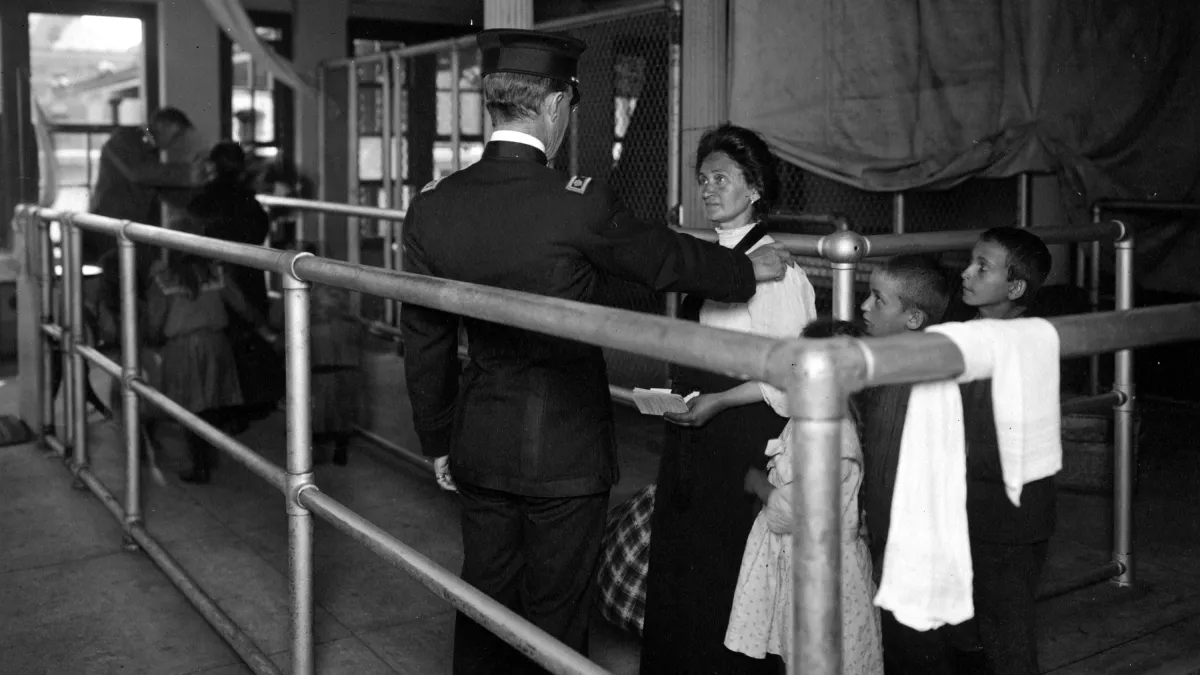 Photo: Ellis Island, via cropper.watch.aetnd.com
 Photo: Maria Esperanza, via www.mariaesperanza.org
She was twenty-six years old, profoundly deaf since childhood, and spoke only broken English. She had no teaching credentials, no connections, and exactly $7.23 to her name. By every conventional measure, she was spectacularly unqualified to revolutionize American education.
But Maria had something the experts lacked: she understood what it meant to struggle with language.
"Most people learn to read by connecting sounds to letters," explains Dr. James Patterson, a literacy researcher at Columbia University. "Maria couldn't hear sounds. She had to find another way — and that other way turned out to work better for millions of children who weren't deaf."
The Failure That Sparked a Revolution
Maria's first job was cleaning classrooms at P.S. 147 on the Lower East Side. Each morning, she arrived before dawn to empty wastebaskets and scrub chalkboards. Each evening, she stayed late to watch teachers struggle with immigrant children who couldn't read English.
The children reminded her of herself — lost in a sea of unfamiliar sounds and symbols, falling further behind each day. She watched six-year-olds labeled as "slow learners" simply because they couldn't decode phonics the way their American-born classmates could.
"The teachers were good people," Maria wrote in her journal, one of the few documents that survived her early years in America. "But they only knew one way to teach reading. If that way didn't work for a child, they had no other ideas."
Maria had other ideas.
During her breaks, she began working with struggling students in the supply closet — the only space she could find. Instead of starting with letter sounds, she started with meaning. She'd show a child a picture of a dog, write the word "dog" beneath it, then have them trace the letters while looking at the image.
She taught them to recognize whole words before breaking them into parts. She used gestures, drawings, and facial expressions to convey meaning. She turned reading into a visual, tactile experience rather than purely auditory one.
The children began to improve.
When Innovation Meets Resistance
Word of Maria's success reached Principal Margaret Hayes, who was initially skeptical. A deaf janitor teaching reading to students that certified teachers couldn't reach? It sounded impossible.
But the results were undeniable. Children who had been failing for months were suddenly devouring books. Parents who spoke little English were amazed to find their kids reading aloud at the dinner table.
Hayes offered Maria a position as a teacher's aide, despite her lack of credentials. It was an unprecedented decision that sparked fierce opposition from the teachers' union and the school board.
"They said I wasn't qualified because I couldn't hear," Maria recalled years later. "I told them that maybe not hearing was exactly why I could help these children. When you can't rely on your ears, you learn to use your eyes and your heart."
The Method That Had No Name
Maria's approach was intuitive rather than systematic. She adapted her techniques to each child's needs, creating visual aids and hands-on activities that made abstract concepts concrete. She taught children to "read" pictures before they read words, to understand stories through context clues and visual patterns.
What she was developing, though she didn't know it at the time, was a comprehensive multi-sensory approach to literacy that would later be called "whole language learning" — though Maria's version was far more sophisticated than the simplified methods that would eventually bear that name.
"She was decades ahead of the research," says Dr. Linda Morrison, author of Silent Teaching: The Maria Esperanza Method. "Modern neuroscience has proven that her instincts about how children learn were remarkably accurate."
By 1932, Maria was running literacy programs in three schools. Her waiting lists grew longer each year as word spread through immigrant communities that there was a teacher who could help any child learn to read, regardless of their background or learning style.
The Student Becomes the Teacher
Maria's breakthrough came when she was asked to train other teachers in her methods. Standing before a room full of certified educators, many with advanced degrees, she faced the ultimate test: could she teach teachers to teach the way she taught?
She started with the same principle she used with children — show, don't just tell.
Maria demonstrated her techniques using volunteers from the audience, turning the training session into a hands-on workshop. She had teachers experience what it was like to learn without relying on sound, to decode meaning through visual and kinesthetic cues.
"She made us realize how much we took for granted," recalled Dorothy Chen, one of Maria's first teacher trainees. "We assumed all children learned the same way we did. Maria showed us there were as many ways to learn reading as there were children in our classrooms."
The Quiet Revolution
By 1950, Maria's methods were being used in over 200 schools across New York City. Teacher training programs began incorporating her techniques. Publishers started creating textbooks based on her visual-first approach to reading instruction.
But Maria herself remained largely invisible. She published no books under her own name. She gave no speeches at education conferences. Her profound deafness and heavily accented English made her reluctant to seek public recognition.
Instead, she worked through other people — training teachers who would train other teachers, developing materials that would be published under other names, creating a movement that spread her ideas without spreading her fame.
"She was the opposite of self-promoting," says Dr. Morrison. "She cared about results, not recognition. As long as children were learning to read, she was happy to let others take credit."
The Legacy Hidden in Plain Sight
Maria Esperanza retired in 1967 after forty-three years in New York City schools. She had personally taught over 3,000 children to read and trained more than 500 teachers in her methods. Her techniques had been adopted by school districts in twelve states.
She died quietly in 1983, leaving behind boxes of handwritten lesson plans, student artwork, and thank-you notes from families whose children had learned to read in her classroom.
Today, elements of Maria's approach are embedded in reading curricula across America. The emphasis on visual learning, the integration of multiple senses, the focus on meaning before mechanics — these are now considered best practices in literacy education.
Most teachers using these methods have never heard of Maria Esperanza. Her name appears in no textbooks, on no monuments, in no halls of fame.
The Teacher Who Changed Everything by Changing Nothing
But perhaps that's exactly how Maria would have wanted it. She didn't set out to revolutionize education — she simply wanted to help children who were struggling the way she had struggled.
"She never thought of herself as an innovator," says Carmen Rodriguez, Maria's last surviving student teacher. "She just saw children who needed help and found ways to help them. Everything else — the recognition, the research, the revolution — that all came later."
In a profession obsessed with credentials and certifications, Maria Esperanza proved that the most powerful qualification for teaching children might be remembering what it felt like to be a child who couldn't learn the way everyone expected you to.
Her silence became her strength. Her struggle became her wisdom. Her disadvantages became her greatest advantages in understanding how to reach the unreachable student.
Today, millions of American children read fluently because a deaf immigrant woman refused to accept that there was only one way to unlock the magic of written language. They'll never know her name, but they carry her gift — the ability to find meaning in symbols, to see stories in pictures, to discover that reading isn't about following rules but about making connections.
Maria Esperanza couldn't hear her students' voices, but she gave them the tools to make sure their voices would be heard forever.