From Bankruptcy Court to Beloved Landmarks: The Architect Who Found His Voice in Financial Ruin
The Fall from Grace Street
Lawrence Chen stood in the marble lobby of his downtown Chicago office building on a Tuesday morning in March 1987, watching federal marshals inventory everything he'd spent two decades building. His architectural firm, Chen & Associates, had been the toast of the Midwest — designing gleaming corporate towers, exclusive country clubs, and luxury condominiums that commanded seven-figure price tags.
Now it was all gone.
The real estate crash had been swift and merciless. Three major projects had been canceled within six weeks. Construction loans came due on buildings that would never be finished. By the time Chen filed for bankruptcy, he owed $4.2 million to creditors and had exactly $847 in his personal checking account.
"I thought I was hot stuff," Chen recalls, sitting in the modest office where he now works. "Glass towers, marble lobbies, spaces that screamed 'Look at me!' I was designing buildings for my ego, not for people."
The bankruptcy proceedings took eight months. When they were finished, Chen had lost his firm, his home, his savings, and most of his friends. At 43, he was starting over with nothing but a pickup truck and a toolbox.
Learning to Build with His Hands
Pride, Chen discovered, was a luxury he could no longer afford. He took the first job he could find: framing houses for a small contractor in suburban Milwaukee. The pay was $12 an hour — less than he used to spend on lunch.
"The first week was humbling," he remembers. "I'd been designing buildings for twenty years, but I'd never actually built one. I didn't know how to use a circular saw properly. The crew had to teach me everything."
But something unexpected happened during those long days of physical labor. Chen began to understand buildings differently — not as abstract concepts on blueprints, but as spaces where real people would live, work, and gather.
He noticed how natural light moved through rooms at different times of day. He felt how ceiling height affected the mood of a space. He learned which materials felt warm to the touch and which ones made a room feel cold and institutional.
"When you're swinging a hammer for eight hours," Chen says, "you have a lot of time to think. I started wondering: what if I'd been designing buildings wrong all along?"
The Revelation in Aisle Seven
Chen's epiphany came in an unlikely place: a grocery store in Kenosha, Wisconsin.
He was shopping for groceries after work one evening when he noticed an elderly woman struggling to reach items on high shelves. A young mother was trying to navigate narrow aisles with a stroller. An elderly man with a walker was having trouble opening the heavy glass doors.
The store was architecturally unremarkable — a basic rectangular box with fluorescent lighting and vinyl floors. But Chen realized it was serving its community in ways his expensive buildings never had.
"That grocery store wasn't trying to win awards," he reflects. "It was just trying to help people get what they needed. And it was doing that job beautifully, even if it wasn't beautiful."
That night, Chen began sketching ideas for public spaces that prioritized function over form, accessibility over aesthetics, community needs over architectural statements.
The Quiet Return
In 1995, after eight years of construction work, Chen quietly reopened his architectural practice. But this time, he focused exclusively on public and community projects: libraries, community centers, playgrounds, and transit stations.
His first commission was a $180,000 renovation of a struggling community center in Racine. The budget was tiny, the timeline was tight, and the building was a 1960s eyesore that most architects would have recommended demolishing.
Chen saw opportunity where others saw obstacles.
He opened up interior walls to create flexible spaces that could serve multiple functions. He added skylights to reduce energy costs and create natural gathering spots. He designed furniture that could be easily moved and reconfigured by community members themselves.
Most importantly, he spent weeks interviewing the people who actually used the building — seniors who came for lunch programs, kids who attended after-school activities, families who rented the space for celebrations.
"I learned more about architecture in those interviews than I had in four years of graduate school," Chen says. "People told me exactly what they needed. I just had to listen."
The Philosophy of Enough
The renovated community center opened to rave reviews — not from architectural critics, but from the people who used it every day. Attendance doubled within six months. Other communities began asking Chen to work similar magic on their neglected public spaces.
Chen developed what he calls "the philosophy of enough" — designing spaces that provide exactly what communities need, nothing more, nothing less.
"Fancy materials don't make people feel welcome," he explains. "Good lighting does. Expensive artwork doesn't create community. Comfortable seating does. Impressive lobbies don't serve the public. Accessible entrances do."
His designs became studies in thoughtful simplicity. He used durable, affordable materials in creative ways. He prioritized natural light over dramatic lighting effects. He created spaces that felt human-scaled rather than monumental.
The Invisible Impact
Over the next two decades, Chen designed or renovated over 200 public spaces across the Midwest. His projects included:
- A transit station in Detroit that reduced crime by 60% simply by improving sightlines and lighting
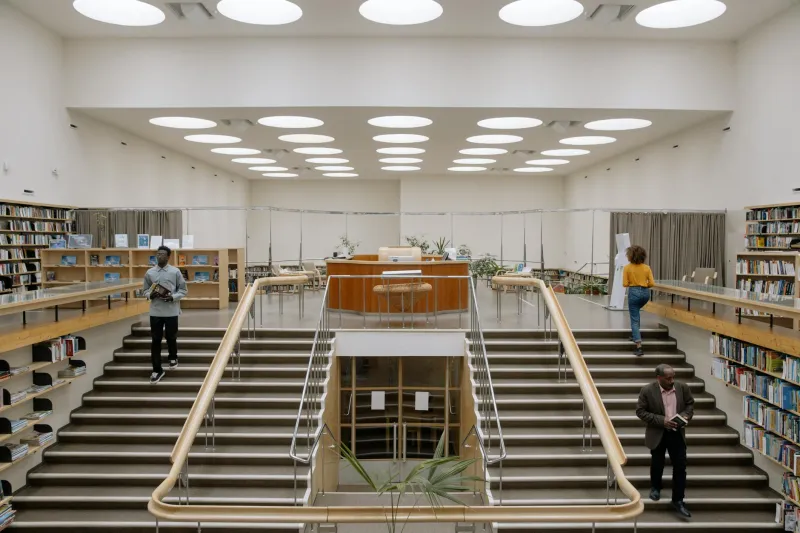
- A library in rural Iowa that became the town's unofficial community center
- A playground in Milwaukee that accommodated children with disabilities without looking like a "special needs" facility
- A farmers market pavilion in Madison that revitalized an entire neighborhood
None of these projects won major architectural awards. None appeared on magazine covers. But all of them served their communities better than the expensive buildings Chen had designed in his previous career.
"Success looks different now," Chen reflects. "It's not about getting your building photographed for magazines. It's about creating spaces where good things happen."
The Measure of a Life's Work
Today, at 79, Chen still maintains a small practice, though he's selective about his projects. His office walls are covered not with architectural awards but with thank-you letters from community groups, photos of children playing in his playgrounds, and newspaper clippings about successful programs in buildings he designed.
His most treasured possession is a worn wooden plaque that hangs behind his desk: "To Mr. Chen, who gave us a place to belong. — The Seniors of Riverside Community Center."
"My first career was about making buildings that impressed other architects," Chen says. "My second career has been about making places where people want to spend time. I wish it hadn't taken bankruptcy to teach me the difference."
Chen's story challenges conventional notions of architectural success. In a profession that often celebrates iconic buildings and celebrity architects, he found fulfillment in anonymous service — creating spaces that work so well that people take them for granted.
The Architecture of Humility
The bankruptcy that destroyed Chen's first career gave birth to his true calling. Financial ruin stripped away his ego and replaced it with empathy. The years spent building with his hands taught him lessons that couldn't be learned from blueprints.
"Losing everything was the best thing that ever happened to my architecture," he says. "When you have nothing left to prove, you can finally focus on what matters — making places where people can live their best lives."
Millions of Americans have used Chen's buildings without knowing his name. They've attended meetings in his community centers, borrowed books from his libraries, waited for buses in his transit shelters. His architecture has become part of the fabric of daily life — invisible, essential, and exactly as it should be.
In the end, Lawrence Chen discovered that the most successful buildings aren't the ones that demand attention, but the ones that quietly serve their purpose so well that they disappear into the background of human experience. Sometimes the greatest architecture is the kind that never tries to be great at all.