Locked In, Looking Out: The Prisoner Who Drew the West Before Anyone Else Got It Right
A Cell With a View of Everywhere
There is a particular kind of attention that confinement produces. When the body cannot move, the mind sometimes compensates with an almost ferocious intensity — reaching outward through whatever materials are available, mapping the world it cannot physically enter. This is not a romantic idea. It is a practical observation about what happens when an intelligent person is left with nothing to do but think.
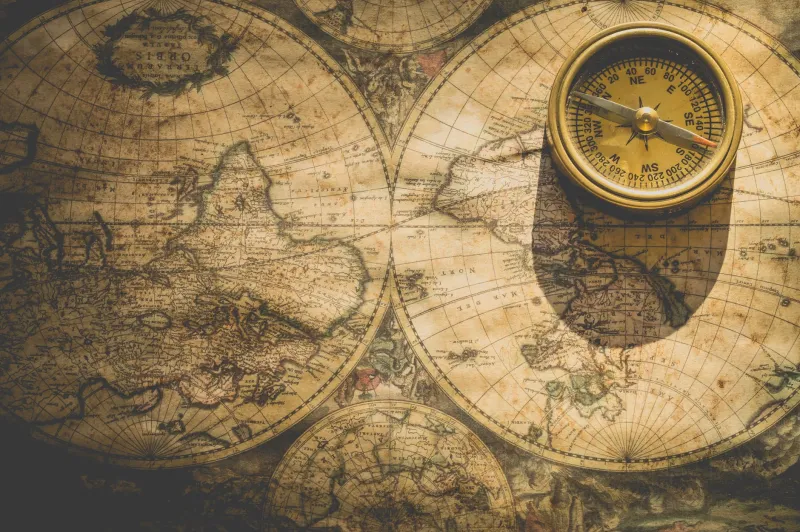
In the mid-nineteenth century, a man serving a multi-year prison sentence in the American interior found himself in exactly that position. He was not a scholar. He had not attended a university or apprenticed under a cartographer or worked for any of the government survey teams that were, at that very moment, trying to make sense of the vast and poorly understood territory west of the Mississippi. What he had was time, a single outdated atlas that had found its way into the prison's small lending collection, and a habit of paying close attention to things that other people overlooked.
 Photo: the Mississippi, via down-sg.img.susercontent.com
He began, almost casually, by noticing the errors.
The Atlas That Was Wrong About Everything
The atlas was already a decade out of date when he got his hands on it, which in the context of mid-nineteenth-century American geography meant it was essentially a work of educated guesswork. The West was being mapped in real time, and the maps were losing the race. River courses were wrong. Mountain elevations were invented. Trail routes that settlers had been using for years were either missing entirely or drawn with a confidence that bore no relationship to the actual terrain.
For most readers, these errors would have been invisible — you can only spot what's wrong on a map if you have some other source of information to check it against. He had that source. He had spent years moving through parts of the country that the atlas had gotten badly wrong, and he remembered what he had seen with an unusual precision. He began making corrections in the margins, small at first, then more extensive as he realized how deep the errors ran.
But marginal corrections weren't enough. He started over.
Using paper he could obtain through the prison's limited supplies, he began redrawing sections of the map from scratch — not just correcting the atlas, but reconstructing what he knew from memory and from the accounts of other prisoners who had traveled through regions he hadn't. He developed a system for distinguishing between what he had seen himself, what he had heard from reliable sources, and what he was inferring from the logic of terrain. It was, without him knowing the formal terminology, a methodology.
The Expertise That Credentials Can't Manufacture
Here is the thing about cartographic precision that the professional surveyors of the era understood intellectually but often failed to practice: a map is only as good as the humility of the person making it. The great errors of nineteenth-century American geography were not usually the result of ignorance. They were the result of overconfidence — of trained men who assumed their instruments and their methods were more reliable than the evidence in front of them.
He had no instruments and no methods. What he had was a profound awareness of his own limitations, because his situation made those limitations impossible to ignore. He couldn't go check anything. He couldn't commission a survey or send an assistant to verify a river's course. Every piece of information he used had to be evaluated carefully, because he had no way to recover from an error except to start over.
That constraint produced a kind of disciplined skepticism that the professional cartographers of his era rarely matched. His maps were covered in qualifications — notations about confidence levels, markers indicating where his information was secondhand, careful distinctions between what was known and what was estimated. This wasn't false modesty. It was precision of a very high order.
The Quiet Influence of an Unsigned Map
The maps he produced did not carry his name in any official sense. They circulated in the way that useful things circulate when the person who made them has no institutional standing — quietly, practically, passed from hand to hand among people who needed them without much interest in where they came from.
Surveyors working in the territories encountered his corrections and incorporated them without attribution, sometimes without even knowing where the corrected information had originated. Settlers heading west along routes he had traced found that his lines matched the ground under their feet in ways that the official maps did not. The work was useful in the most direct possible sense, and its usefulness spread in proportion to that directness.
He was released eventually, as people are. The record of what he did afterward is thin. He didn't become a celebrated figure or found a cartographic firm or receive any formal recognition from the survey establishment he had quietly outperformed from inside a cell. The nineteenth century was not in the habit of crediting the work of incarcerated men, and the maps themselves had long since been absorbed into the broader body of geographic knowledge without anyone keeping careful track of their origins.
What the Walls Actually Contained
The story of his maps is, at one level, a story about the American West and the chaotic, collaborative, often anonymous process by which it was eventually understood. But it is also a story about what confinement cannot take from a person.
The prison walls contained his body. They did not contain his geographic memory, his analytical intelligence, his capacity for sustained and careful work, or his instinct for the kind of precision that comes from knowing you cannot afford to be wrong. Those things were his regardless of his circumstances, and the circumstances — by removing every other option — forced him to use them fully.
The atlas that started it all was wrong about almost everything. What it accidentally gave him was a problem worth solving and enough time to solve it. In the long history of unlikely expertise, that combination turns out to be surprisingly powerful.