The Man Who Couldn't Speak Fast Enough — So He Learned to See Better Than Anyone
The Room Where Words Move Money
Picture a packed auction house on a Tuesday evening. Paddles raised. Phones ringing. A room full of collectors, dealers, and ego, all waiting for the gavel to drop. In that world, the auctioneer is everything — a performer, a ringmaster, a human pressure cooker designed to extract maximum value from a crowd that knows exactly what it's doing.
Now picture a young man standing at the podium with a stammer so severe that some mornings he couldn't get through his own name.
That was Elias Crowe in 1947. And the auction world had absolutely no idea what was about to happen to it.
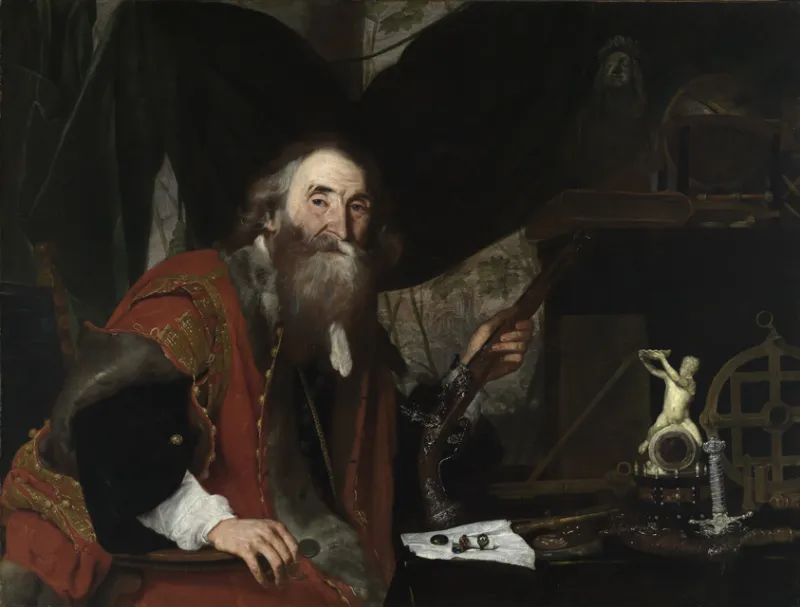
 Photo: Elias Crowe, via files.musicful.ai
A Childhood Spent Listening
Crowe grew up in Cincinnati, Ohio, the son of a furniture repairman who moonlighted as an estate liquidator. From the time he was eight years old, Elias tagged along to sales in old farmhouses and stuffy parlors, watching strangers haggle over the remnants of other people's lives.
He couldn't talk easily. So instead, he watched.
He watched how people touched objects before they bid. How a woman's jaw tightened slightly when she wanted something badly. How a man in an expensive suit would walk past a painting three times before pretending he hadn't noticed it. While other kids his age were learning to talk their way through the world, Elias was quietly cataloging human desire in all its unguarded forms.
By the time he was a teenager, he could look at a room full of strangers and tell you, within two or three bids, who was going to buy what — and roughly how much they'd pay.
The problem was, nobody was asking him.
Stumbling Into the Room
Crowe's entry into the formal auction world was less a career move than an accident. At twenty-two, he was working as a runner for a small Cincinnati auction house — fetching catalogs, arranging chairs, staying out of everyone's way — when the house's lead auctioneer collapsed backstage with a suspected heart attack twenty minutes before a major estate sale.
The owner, a man named Harlan Beech, looked around the room in a panic. There were forty buyers seated and a collection of nineteenth-century American paintings worth more than the building they were sitting in.
Elias was the only person backstage who had watched enough sales to know the order of the lots.
"D-d-don't worry," Crowe reportedly told Beech. "I kn-know every piece."
Beech had no other options.
What happened next became something of a legend in regional auction circles. Crowe's delivery was halting, unpolished, and nothing like the slick patter buyers were used to. But in the pauses — in the long, searching silences between his words — something strange happened. Buyers looked harder at the paintings. They leaned in. They filled the quiet with their own desire.
The sale cleared 40 percent above estimate.
The Pause as a Tool
Crowe spent the next decade quietly building a reputation that defied easy explanation. He was not a gifted speaker. He would never be. But what he had developed — out of pure necessity — was an almost supernatural ability to read a room.
He knew which lots to linger on and which to move through quickly. He knew when a bidder was bluffing and when they were genuinely stretched. He understood, in a way that no amount of auctioneer training could teach, that silence isn't dead air. It's pressure. And pressure, applied at exactly the right moment, moves money.
He also had an eye for the art itself that left dealers genuinely unsettled. Because he had spent so much of his childhood studying objects rather than talking about them, Crowe could assess a painting's condition, provenance, and emotional resonance in the time it took most appraisers to uncap a pen. He wasn't formally trained. He had simply looked at more things, more carefully, than almost anyone alive.
By the mid-1950s, he had opened his own house in Chicago. By 1962, Crowe Fine Arts had offices in New York and San Francisco.
What the Polished Guys Missed
The fine art auction world of mid-century America was a deeply insular place — white-gloved, Ivy-credentialed, and deeply suspicious of anyone who hadn't come up through the right channels. Crowe had come up through none of them.
That turned out to be an enormous advantage.
While his competitors were busy performing expertise, Crowe was busy observing it. He built relationships with artists and collectors who felt overlooked by the established houses — people who didn't speak the right dialect of cultural authority but who had genuine taste and real money. He cultivated emerging American painters at a time when the major houses were still chasing European provenance, and he was right about nearly all of them.
His staff learned quickly that the boss's stammer was not something to work around. It was something to study. When Elias paused in the middle of a lot description, it wasn't because he was struggling. It was because he'd seen something in the room worth seeing.
"He talked slow," one longtime employee recalled years later, "but he thought about ten times faster than anyone I've ever met."
The Empire Built in Silence
By the time Crowe retired in 1981, his company had facilitated the sale of more than a billion dollars in American fine art — a figure that placed him in the same conversation as institutions that had been operating for a century before he was born.
He never lost the stammer. He never stopped being the guy in the room who watched more than he spoke.
But he also never stopped believing that the thing that had made his childhood harder had made his career possible. In a world that rewards confident performance, Crowe had been forced to develop something rarer: genuine perception.
The auction world taught him nothing. It just gave him a room to practice what his stutter had already built.
Sometimes the obstacle isn't in the way. Sometimes it is the way — if you're patient enough to figure out what it's actually teaching you.