The Kitchen Revolutionary Who Started in Disgrace: How Two F's Sparked a Design Revolution
The Report Card That Changed Everything
Lillian Moller stared at the red ink sprawled across her home economics report card: F in "Kitchen Management," F in "Domestic Planning." Her teacher's handwritten note was even more brutal: "Miss Moller lacks any instinct for efficient domestic space. Recommend redirecting toward secretarial training."
It was 1896, and for a young woman in Oakland, California, failing home economics wasn't just an academic setback—it was social exile. The course was designed to prepare girls for their inevitable roles as housewives. Failing it twice suggested something fundamentally wrong with her feminine instincts.
 Photo: Oakland, California, via download.logo.wine
Lillian's parents, mortified by the teacher's assessment, enrolled her in business school instead. She would learn to type and take dictation, skills deemed appropriate for someone so clearly unsuited for domestic life.
None of them could have imagined that those failures would eventually revolutionize every kitchen in America.
The Outsider's Advantage
While her classmates learned to arrange parlors and plan menus, Lillian discovered engineering. At UC Berkeley—one of the few universities accepting women in technical programs—she studied the emerging science of industrial efficiency. She learned to break complex processes into component parts, to measure motion and eliminate waste.
 Photo: UC Berkeley, via www.sasaki.com
Most importantly, she learned to see systems rather than traditions.
After marrying fellow engineer Frank Gilbreth, Lillian found herself managing not just a household, but a household with twelve children. The domestic space she'd supposedly had no instinct for suddenly became her laboratory.
"I approached our kitchen like any other inefficient system," she later wrote. "I timed every movement, measured every reach, calculated every step. What I found was appalling."
The Science of the Kitchen Triangle
The typical 1920s kitchen was designed by men who'd never cooked in one, based on traditions that prioritized appearance over function. Sinks were placed under windows for light, regardless of workflow. Stoves stood wherever plumbing and gas lines made installation cheapest. Storage was arranged for visual symmetry rather than logical access.
Lillian began timing her own cooking processes, discovering that the average housewife walked unnecessary miles each day simply preparing meals. She calculated that poor kitchen design was costing American women collectively millions of hours annually—time that could be spent on education, careers, or family.
"The kitchen isn't a showroom," she argued in her groundbreaking 1927 study. "It's a workplace. And like any workplace, it should be designed for the person who works there."
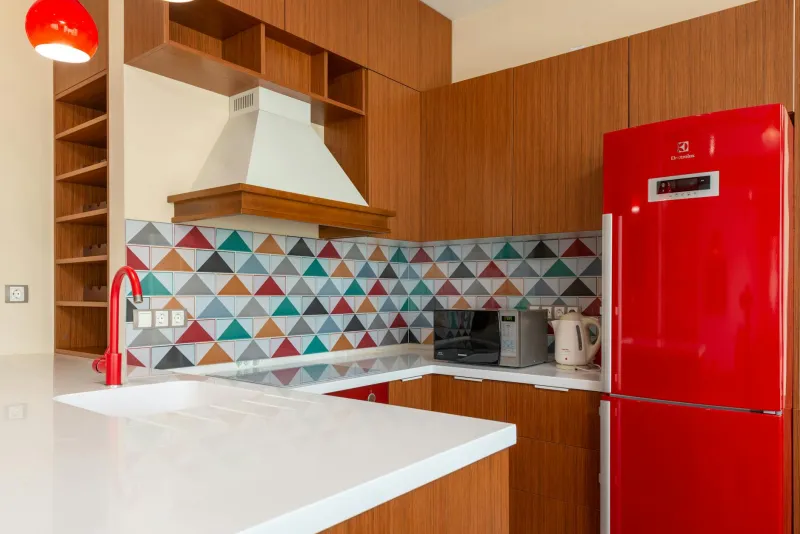
Her revolutionary insight was the kitchen work triangle—the optimal positioning of sink, stove, and refrigerator to minimize movement while maximizing efficiency. She specified ideal counter heights, cabinet depths, and storage locations based on actual human motion rather than aesthetic preference.
Fighting the Establishment
The home economics establishment that had once failed her now actively opposed her ideas. Traditional teachers argued that efficient kitchens would make women lazy, that struggling with poor design built character. Kitchen manufacturers resisted her standardized measurements, preferring custom installations that generated higher profits.
"Mrs. Gilbreth's approach treats the kitchen like a factory," huffed one prominent home economics textbook. "A woman's place is to adapt to her domestic environment, not demand that it adapt to her."
But Lillian had something her critics lacked: data. Her time-and-motion studies proved that well-designed kitchens didn't make women lazy—they freed them to spend time on activities beyond food preparation. Her ergonomic principles reduced back strain and fatigue. Her storage systems eliminated the daily hunt for misplaced tools and ingredients.
The Transformation of American Homes
By the 1930s, forward-thinking architects and builders were quietly implementing Gilbreth's principles. Post-war housing developments embraced her kitchen triangle design almost universally. The ranch houses that defined 1950s suburbia featured kitchens laid out according to specifications developed by the woman who'd supposedly had no domestic instincts.
Appliance manufacturers began designing products to fit her ergonomic standards. Cabinet makers adopted her storage principles. Even the height of standard kitchen counters—36 inches—was based on Lillian's measurements of efficient working positions.
"She took the mystery out of kitchen design," explained architect Joseph Eichler, whose modernist homes featured Gilbreth-inspired kitchens. "Instead of guessing what might work, she proved what actually did work."
The Vindication
By the time Lillian Gilbreth died in 1972, virtually every American kitchen reflected principles she'd developed. The work triangle had become standard architectural practice. Her ergonomic measurements were industry standards. Her storage solutions were assumed wisdom.
 Photo: Lillian Gilbreth, via platform.sbnation.com
The woman who'd failed home economics had become the hidden architect of domestic efficiency. Her influence was so complete it had become invisible—the mark of truly revolutionary design.
Perhaps her high school teacher had been right about one thing: Lillian Moller really did lack instinct for domestic space. She had something far more valuable instead: the outsider's clarity to see that space as it actually was, rather than as tradition said it should be.
Sometimes the greatest innovations come not from mastering a field, but from being rejected by it completely.