Every Investor Said No. Then the Entire Country Said Yes.
The Pitch Nobody Wanted
Walter Goss had a gift for walking into rooms and leaving them exactly the same size as when he entered — which is to say, rooms full of skeptical men who had heard a lot of ideas and were not impressed by his.
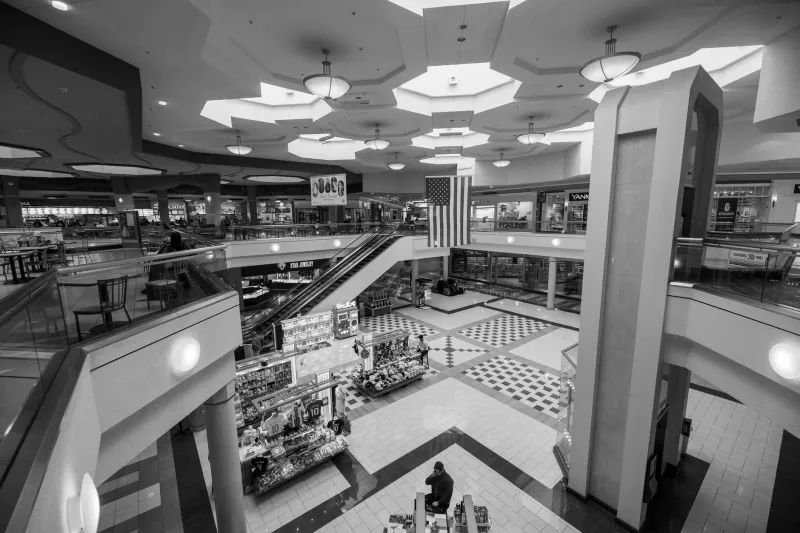
The pitch was simple enough to state and apparently impossible to take seriously: a single, enclosed, climate-controlled space where dozens of different retailers would operate under one roof, sharing parking, foot traffic, and infrastructure costs, while offering customers the ability to shop for everything from shoes to appliances to groceries without stepping outside. Goss called it, in his early presentations, a "shopping village under glass."
The investors called it a fantasy.
This was the early 1960s, and the retail landscape of the United States was organized around a different logic entirely — the logic of the downtown commercial strip, the standalone department store, the neighborhood shop. The idea that you could artificially concentrate retail activity inside a single structure and expect customers to drive to it, park, and spend an afternoon there struck most of the people Goss pitched as either naive or delusional. A few were kind about it. Most were not.
One venture investor in Manhattan, according to a letter Goss kept for the rest of his life, described the concept as "the retail equivalent of building a city inside a bottle and hoping people would prefer it to the actual city."
Goss wrote back thanking him for his time.
Where the Idea Came From
To understand why Goss believed so stubbornly in something the market was rejecting so completely, you have to understand where the idea originated — which was not in a business school or a retail consultancy but in a memory.
Goss had grown up in a small town in Ohio where the commercial center of community life was a covered market — a structure that had existed in some form since the nineteenth century, where vendors of every kind gathered under a single roof and the act of shopping was also, inevitably, a social experience. People lingered. They ran into neighbors. They stayed longer than they had planned because the environment invited it.
When Goss moved to a larger city as a young man and watched the postwar retail boom unfold, he kept noticing the same thing: the new standalone stores were efficient and well-stocked, but they were also oddly isolating. You drove to one store, completed a transaction, drove to the next. The social dimension of commerce — the thing that had made the covered market a genuine gathering place — had been stripped out in the name of convenience.
His pitch was, at its core, an attempt to put that dimension back. He was not describing something invented from nothing. He was describing something very old, reimagined for a car-dependent, suburban America.
The investors couldn't see the old thing inside the new idea. They only saw the new idea, and it looked impractical.
The Education of Public Rejection
Between 1961 and 1967, Goss was rejected by, by his own count, more than forty separate investors and retail groups. He kept a log. Not out of masochism, but because he was paying close attention to the specific nature of each objection, and the objections were teaching him things.
Some of the concerns were legitimate. The infrastructure costs of building and maintaining an enclosed retail environment were genuinely significant, and his early financial projections had underestimated them. He revised. Some of the concerns reflected assumptions about consumer behavior that Goss thought were wrong, but he couldn't prove it yet — he needed data he didn't have.
So he found a way to get it.
Using a small amount of capital raised from family members and a bank loan secured against his house, Goss leased a vacant warehouse on the outskirts of a mid-sized city in the Midwest and spent eighteen months running what he described as an experiment in retail anthropology. He invited a rotating cast of small retailers to set up temporary stalls inside the space. He charged minimal rent. He observed.
What he observed was that people stayed. They arrived intending to buy one thing and left having bought four. They came back the following weekend. They brought their families. The average time spent inside the space was more than two hours — a figure that would have seemed impossible to any of the investors who had laughed at him.
He photographed everything. He documented the foot traffic patterns, the dwell times, the purchasing sequences, the social interactions. He built a data set that no one else in retail had, because no one else in retail had been desperate enough to go find it themselves.
The Moment the Room Stopped Laughing
In 1968, Goss walked into a meeting with a regional real estate developer who had heard about the warehouse experiment through a mutual contact. He brought the data. The developer, a practical man with no particular investment in conventional wisdom, looked at the numbers for a long time without speaking.
Then he asked how much Goss needed.
The first enclosed retail complex built to Goss's specifications opened in 1971. It was not an immediate sensation. The first six months were difficult, the foot traffic slower than projected, the anchor tenants nervous. Goss spent those six months on-site, adjusting the layout, repositioning signage, working with individual retailers on merchandising strategies that took advantage of the environment rather than ignoring it.
By the end of the first year, the numbers had turned. By the end of the third year, they were extraordinary. By the time competitors began building their own versions, Goss had opened four more and was in negotiations for three additional sites.
The investors who had rejected him began calling. He took the calls. He was polite. He did not frame the conversations as vindication, though privately he allowed himself a small amount of satisfaction each time.
What the Humiliation Actually Built
The easy version of Goss's story is that he was right and everyone else was wrong, and eventually the world caught up. That version is true as far as it goes, but it misses the more interesting part.
The years of rejection were not simply an obstacle between Goss and his success. They were the laboratory in which his understanding of the concept became deep enough to actually execute it. Every objection he absorbed forced him to think harder about the thing he was proposing. The warehouse experiment — which he never would have run if a conventional investor had simply handed him money in 1962 — generated knowledge that no amount of theoretical planning could have produced.
The humiliation, in other words, was doing work. It was forging something that comfort would never have produced: an operator who understood his own model at a level his better-funded competitors would spend years trying to match.
Retail has changed enormously since Goss built his first enclosed complex. The format he pioneered has evolved, struggled, and adapted in ways he could not have predicted. But the underlying insight — that shopping is a social experience, that people will go out of their way for an environment that rewards lingering, that the transaction is almost secondary to the atmosphere in which it occurs — has never stopped being true.
He figured that out in a warehouse, with borrowed money and forty rejection letters in a file drawer, because no one would let him do it the easy way.
Some gifts only come wrapped in that particular paper.