Thirty Years in the Basement: The Quiet Hands That Kept the Moon From Crumbling
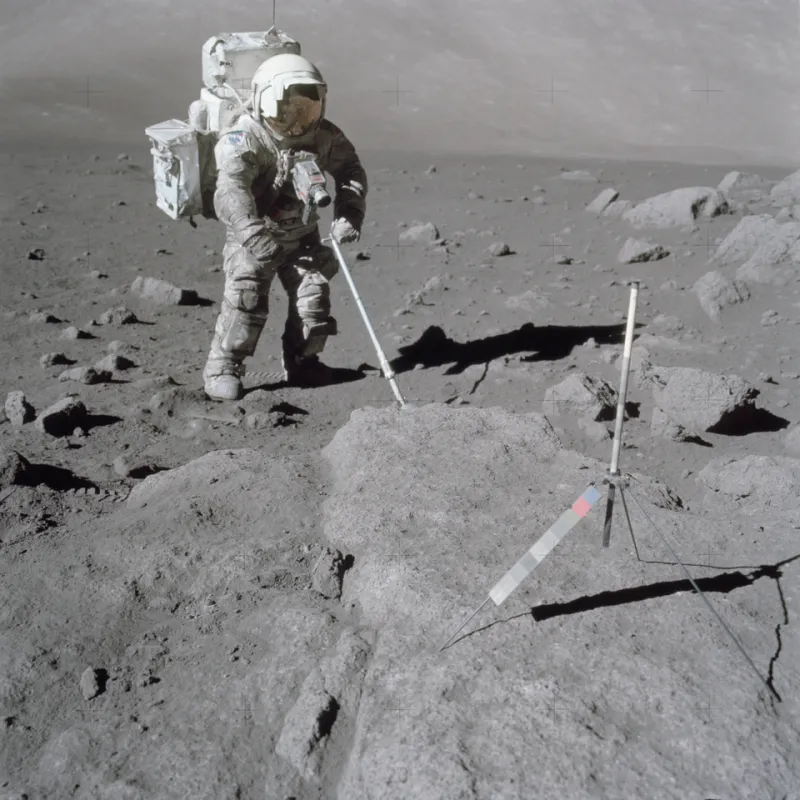
Photo: NASA/Eugene A. Cernan, Public domain, via Wikimedia Commons
The Room Nobody Visited
Down a corridor at the Johnson Space Center in Houston, past the mission control theaters where crowds gather to gawk at the consoles of legend, there are rooms most visitors never see. No glass walls. No plaques. Just nitrogen-purged cabinets, stainless steel tools, and people in clean-room smocks working with the patience of monks.
That's where the moon lives.
When Apollo 11 came home in July 1969, it brought back 48 pounds of rock and soil from another world. And almost immediately, NASA confronted a problem nobody had fully thought through: who takes care of this stuff — forever?
A Job With No Finish Line
The lunar sample curators who took on that question signed up for something strange in American work culture: a job that would never be done. The samples were divided — some for active research, some sealed for scientists of the future, kept untouched on purpose. The Apollo 11, 12, and 17 sealed vaults weren't opened for decades, and the stated hope was that some would stay sealed for fifty years or more, waiting for instruments that hadn't been invented yet.
Think about what that requires. Not brilliance. Not courage in the cinematic sense. It requires showing up every day, decade after decade, and doing the same meticulous work with zero applause. Checking seals. Logging temperatures. Making sure a single grain of regolith — dust that traveled 238,000 miles — doesn't wander off or get contaminated by a fingerprint.
The Man Who Said 'Not Yet'
Here's where the story turns from admirable to remarkable. In the early 2000s, researchers came looking for sealed samples from Apollo — soil collected at the very edge of the trench astronauts dug, material untouched since it was scooped up. The scientific community had largely assumed some of the early sealed vaults couldn't be practically opened without destroying what was inside. The technology to do it safely didn't exist in 1969, and everyone knew it.
The curators' answer wasn't a shrug. It was stewardship. They kept those containers stable through budget cuts, through shuttle disasters, through decades when nobody outside the building cared about moon rocks at all. When NASA finally launched the Apollo Next Generation Sample Analysis program in the late 2010s — opening sealed samples with modern tools — the material inside was pristine. Fifty years of patience paid off in a single afternoon of discovery.
The people who made that afternoon possible weren't famous. Many never gave a press interview. They just refused to let the work degrade on their watch.
What Custody Actually Means
We tend to picture heroism as a moment — the splashdown, the handshake, the ticker-tape parade. But custody is a virtue of duration, not drama. A sample curator's career is measured in the absence of incidents. Success looks like nothing happening, for thirty years.
There's a lesson in that for anyone building anything worth keeping. The startup that survives isn't the one with the flashiest launch; it's the one where somebody kept the books clean, the backups current, the culture intact while everyone else chased headlines. The moon rocks survived because someone treated a Tuesday like it mattered as much as a launch day.
The Unopened Present
NASA still holds back a portion of the Apollo collection, deliberately unopened, for scientists not yet born. Some samples are being studied today with equipment that would look like sorcery to the engineers of 1969. Every one of those future discoveries is, in a real sense, a gift from people whose names most of us will never learn.
The astronauts went to the moon and came back. But keeping the moon — keeping it honest, clean, and whole for half a century — happened in the basement. And it happened because ordinary people decided that quiet diligence was a form of greatness.
History doesn't only remember the launch. Sometimes, if we look closely, it remembers who kept the lights on afterward.