The Math They Said He'd Never Touch — And the Code He Left for Millions

The Math They Said He'd Never Touch — And the Code He Left for Millions
There's a particular cruelty in being told you can't do the thing you love most. It's worse when the people saying it believe they're being kind.
Abraham Nemeth heard that message so many times, from so many well-meaning voices, that he could have been forgiven for eventually believing it. He was blind from birth, growing up in New York City in the 1920s, a kid who fell in love with numbers before he fully understood what that love would cost him. The adults around him weren't monsters. They were operating on the honest assumption that mathematics — visual, symbol-dense, built on a written language of its own — was simply inaccessible to someone who couldn't see. They thought they were protecting him.
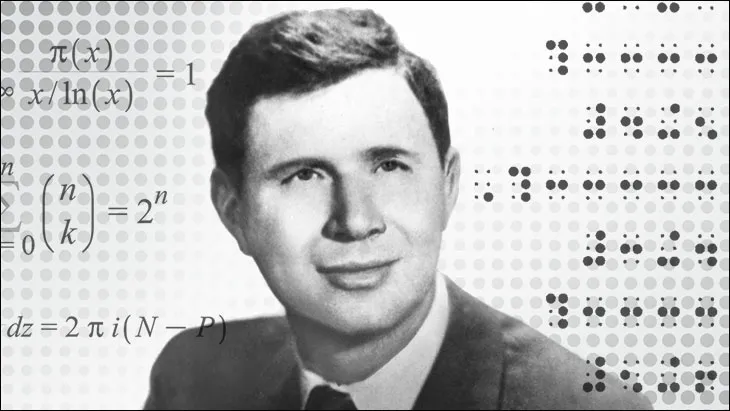 Photo: Abraham Nemeth, via aish.com
They were wrong. And the proof of that wrongness now lives in the hands of millions of people worldwide.
A Door That Kept Closing
Nemeth was sharp. Everyone who encountered him knew it. He moved through his early education at the New York Institute for the Blind with a clarity of mind that impressed teachers and frustrated the system in equal measure. When he applied to study mathematics at the college level, he was steered away — gently, persistently, with all the condescension that passes for guidance when institutions don't know what to do with someone who doesn't fit the template.
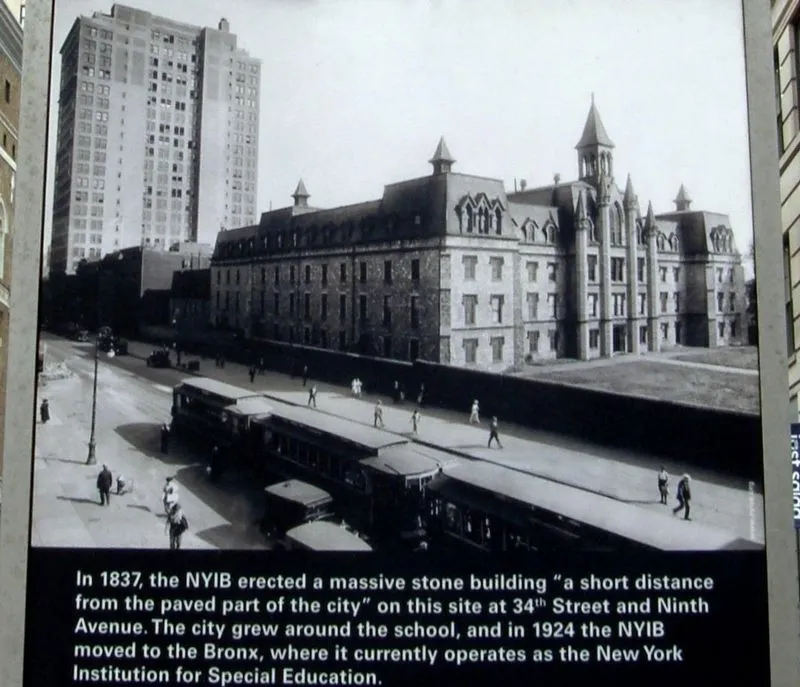 Photo: New York Institute for the Blind, via www.hmdb.org
The reasoning was circular in that infuriating way that bad advice often is: mathematics requires written notation, written notation requires sight, therefore mathematics requires sight. Nemeth didn't have sight, so mathematics was not for Nemeth. Case closed. Move along.
He didn't move along. But he did pivot — for a while, at least. He earned a degree in psychology, then another. He worked. He built a life. But the numbers never left him alone, and eventually, in his late twenties, he went back. He enrolled at Brooklyn College to pursue mathematics formally, and this time, he refused to be redirected.
What he found when he got there was a problem nobody had bothered to solve: there was no reliable system for representing advanced mathematics in Braille.
Building the Language Nobody Had Written
Standard literary Braille — the system developed by Louis Braille in the 1820s — handled words beautifully. But mathematics isn't words. It's fractions and exponents and radicals and Greek letters stacked in relationships that carry meaning through their spatial arrangement. Translating that into a linear, tactile code without losing the mathematical logic was an extraordinary challenge. The existing attempts were inconsistent, incomplete, and largely unusable for anything beyond basic arithmetic.
Nemeth started building his own system. He did it the way you do something when there's no blueprint: by starting with first principles, making decisions, testing them against real problems, and revising. He worked through his graduate studies using the notation he was inventing as he went, essentially creating the tool he needed at the same time he was using it.
This is the part of the story that deserves a moment of genuine appreciation. Nemeth wasn't just solving his own problem. He was solving it for everyone who would come after him — all the blind students who would someday want to study calculus, physics, chemistry, engineering. He was building a road while walking it.
The Nemeth Braille Code for Mathematics and Science Notation was formally adopted by the Braille Authority of North America in 1952. It remains in use today.
What Rejection Actually Built
It would be too simple to say that the people who turned Nemeth away were the reason he succeeded. Causality in a human life is messier than that. But there's something worth sitting with in the specific shape of what he created.
Because Nemeth was excluded from the standard pathways — because he was never handed a working system and told to use it — he was forced to understand mathematics from the inside out, to think about how symbolic language actually functions, what it's doing when it represents a concept, how structure carries meaning independent of visual form. That depth of understanding was precisely what the code-building required.
A sighted mathematician handed the same task might have tried to visually replicate standard notation in tactile form. Nemeth, who had never experienced mathematical notation visually, approached it from a different angle entirely. He thought about what the notation needed to do, not what it needed to look like. That distinction produced something more elegant and more functional than a direct translation would have been.
The exclusion, in other words, wasn't incidental to the achievement. It was architectural.
A Legacy Written in Touch
Nemeth went on to earn his doctorate in mathematics from Wayne State University, teach for decades, and become one of the most respected figures in the field of accessible education. He was, by any measure, exactly the kind of mathematician those early advisors had told him he couldn't be.
 Photo: Wayne State University, via wallpapers.com
But the Nemeth Code is the thing that outlasts all of it. Every blind student who works through a calculus problem, every visually impaired engineer who reads a formula, every kid who gets to discover that numbers make sense to them — they're all moving through a system one man built because the existing world had no room for him.
There's a version of Abraham Nemeth's story where he accepts the early guidance, finds a different path, and lives a perfectly good life. That version exists. But in that version, the code doesn't get written. The door stays closed, not just for him, but for everyone standing behind it.
He didn't accept the guidance. He built the door himself. And then he left it open.